
What kind of robot is MiniDuck?
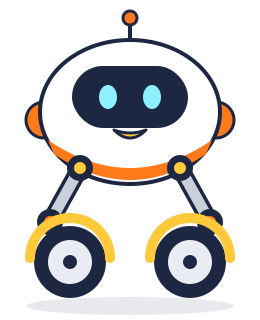
Engineering codename: Octopus Nova Rover. A white oval body with orange trim, exposed joints and yellow wheel covers. It is a desktop-sized wheel-legged robot that can balance, move, see and listen on flat indoor floors.
V1 design targets
| Layout | Two wheels + two joints per leg (hip and knee) |
|---|---|
| Degrees of freedom | 4 leg joints + 2 wheel drives |
| Height | About 280–330 mm |
| Weight | Target 2–3 kg |
| Top speed | Limited to 0.3 m/s at first |
| Self-balancing | Standing, driving forward and back, turning |
| Interaction | Voice, camera, LED expressions |
| AI | Nova Agent, vision-language model (VLM), tool calling |
| Environment | Flat indoor floors, no stairs |
| Battery life | Target 30–60 minutes |
V1 will not jump or do stunts. Stable standing, driving, fall detection and safe shutdown come first; getting back up and dynamic moves come later.
Six joints, left and right
Joint layout
- Left hip L-HIP · left knee L-KNEE · left wheel L-WHEEL
- Right hip R-HIP · right knee R-KNEE · right wheel R-WHEEL
This naming and basic structure match the open-source Upkie robot, so we can build on its kinematics and control code.
Materials
- Shell: 3D-printed PETG, 2.5–3 mm walls
- Joint brackets: aluminium
- Fasteners: steel
- Tyres: non-slip TPU
The printed shell does not carry the joint loads; the metal brackets do.
| Part | Starting dimension |
|---|---|
| Body shell | 180 × 110 × 85 mm |
| Thigh link | 80 mm |
| Shin link | 85 mm |
| Wheel diameter | 90 mm |
| Track width | 190–220 mm |
These are starting points for CAD. We still need to check tyre clearance, joint range, centre of mass and room for wiring.
Not the AI model, but the actuators
Actuators are the robot’s muscles. If the joint motors are not strong, fast or precise enough, no amount of clever AI will make the robot stand.
Cheap serial bus servos are fine for early structural tests, but the kg·cm number on the box is not enough. We need to measure continuous torque, speed, backlash, heating and control latency.
So for the first two weeks we do the dynamics maths and test actuators before buying parts for the whole robot.
A quick calculation
Assume the robot weighs 2.5 kg, its centre of mass is 0.15 m above the wheel axle, and it leans 10°:
τ ≈ m·g·h·sin(10°) ≈ 0.64 N·m
This is a simplified estimate of the overall tipping torque from gravity, not the torque each motor needs. The real numbers also depend on acceleration, wheel grip, gear ratio and impacts.
We will simulate three cases: standing still, balancing while speeding up and slowing down, and recovering from a squat. We will lock in the actuator model only after we know the peak and continuous torque.
Nova Agent + Robot Runtime
The AI sends an intent. The Robot Runtime checks it, carries it out and reports back. The lower the layer, the faster it runs, the closer it is to the hardware, and the higher its priority.
| Module | Planned technology | Update rate |
|---|---|---|
| Motor current loop | Inside the motor driver | 1–20 kHz |
| Balance control | STM32 C/C++ | 500–1,000 Hz |
| State estimation | IMU + encoder fusion | 200–500 Hz |
| Motion planning | ROS 2 / C++ | 20–100 Hz |
| Vision | OpenCV / VLM | 5–30 FPS |
| Speech recognition | Whisper or another ASR | Event-driven |
| Agent decisions | Nova Agent | Event-driven |
| Memory | SQLite / vector database | On demand |
Rates are design targets. Whether we hit them depends on the hardware, the drivers and real-time scheduling tests.
“Come and look at what’s on the table”
When you say this to MiniDuck, the system works through these steps:
- Nova understands the task and finds the target
- Vision locates the target and any obstacles
- Motion planning works out an allowed path
- The controller keeps balance while driving
- On arrival, the camera takes a picture
- The VLM describes the object and answers out loud
Every action is a Skill call with safety limits attached:
{
  "robot_id": "nova-rover-001",
  "skill": "move",
  "arguments": {
    "direction": "forward",
    "distance_m": 0.5,
    "max_speed_mps": 0.15
  },
  "safety": {
    "obstacle_check": true,
    "require_balance": true,
    "timeout_ms": 10000
  }
}Fall over a thousand times in software first
MuJoCo
Fast iteration on dynamics, joint models, balance algorithms and control gains.
NVIDIA Isaac Sim
Simulates the wheel-legged robot, its sensors and indoor scenes. Later we can try reinforcement learning with Isaac Lab.
Starting from Upkie
Upkie has open-sourced Python/C++ control, PyBullet simulation and balancing examples. We start there and move to MiniDuck’s own URDF model.
We changed the actuators, dimensions, weight and wheel size, so Upkie’s balance tuning will not carry over. We have to simulate and tune again.
The 12-week plan
Mechanics & simulation
CAD, URDF, centre-of-mass calculation, actuator selection and a first balance simulation.
Hardware build
3D-print the shell, fit the wheel drives, joints, sensors and power system, and test each actuator.
Balance control
State estimation, wheel speed control, standing balance and basic forward and backward motion.
ROS 2 & motion interface
Speed control, turning, squatting, remote control, status feedback and the emergency stop.
Nova Agent integration
Camera, microphone, voice interaction, task planning and Robot Skills.
Integration & acceptance
Obstacle detection, fault protection, battery testing, the demo routine and operating docs.
V1 acceptance tests
| Test | Pass criteria |
|---|---|
| Self-balancing | Stays balanced on a flat floor for 60 seconds |
| Driving | Drives 2 m forward, stops and reverses |
| Turning | Turns 90° on the spot |
| Voice | Recognises and carries out 5 predefined commands |
| Vision | Recognises a named object and describes it |
| Safety | E-stop, link-loss and fall protection all work |
| Battery | At least 30 minutes, measured |
| Logging | Records actions, sensor data and errors |
We will post the result of every test, pass or fail, in the build log.
Standing on the shoulders of the open-source community
We start from Upkie’s proven balance control, then replace the shell, computer, sensors and AI piece by piece. MiniDuck’s code will be organised as shown here. Later, Nova Agent’s physical AI layer could become an SDK for robots of other shapes.
References: Upkie on GitHub · Upkie build guide
nova-rover/
├── hardware/      # CAD, electronics, BOM
├── firmware/
│   └── stm32-motion/
├── robot-runtime/
│   ├── ros2/  perception/
│   └── motion/  safety/
├── nova-agent/
│   └── skills/  planner/  memory/
├── simulation/
│   └── urdf/  mujoco/  isaac/
└── tests/